
Silk Fly Line Manufacturing: A Brief History
By John Mundt (The American Fly Fisher – Fall 1991 – Article)
The practice of using fly lines made of horsehair and silk is well documented in the lore of angling, however, information on the actual manufacture of these lines is much more limited. Early English publications, such as “A Treatyse of Fishing with an Angle” (1496), author undocumented but popularly attributed to Dame Juliana Berners, and The Compleat Angler or The Contemplative Man’s Recreation (1653), by Izaak Walton and Charles Cotton, provided detailed instructions on how to fabricate lines made of horsehair, as well as other tackle. From the fifteenth through the seventeenth centuries there was no firmly established tackle industry, thus prospective anglers had to rely on these and other reference books to equip themselves. As the tackle industry developed over several centuries, an angler no longer had to produce his or her own tackle but could readily purchase the required items. When the market grew enough so that demand could be met, published material on how to make lines diminished and what had been published was not always archived. This explains why there is only nominal documentation on the subject available today.
By tracing the evolution of the fly line, it is possible to gain a more detailed perspective on the construction methods used over the ages. The Compleat Angler by Walton and Cotton (fourth London edition) gives the reader instructions on how to properly select and prepare horsehair for weaving or “twisting” into a functional line. This classic volume goes a step further by describing the various methods of “dyeing your hairs.” In the following passage Sir Izaak instructs the reader how to collect raw material and prepare it for assembly into a line.
“And for making your line, observe this rule, first let your hair be clean washed ere you go about to twist it: and then choose not only the cleanest hair for it, but hairs that be of equal bigness, for such do usually stretch all together, which hairs of unequal bigness never do, but break singly, and so deceive the Angler that trusts to them…
When you have twisted your links, lay them in water for a quarter of an hour at least, and then twist them over again before you tie them into a line.“
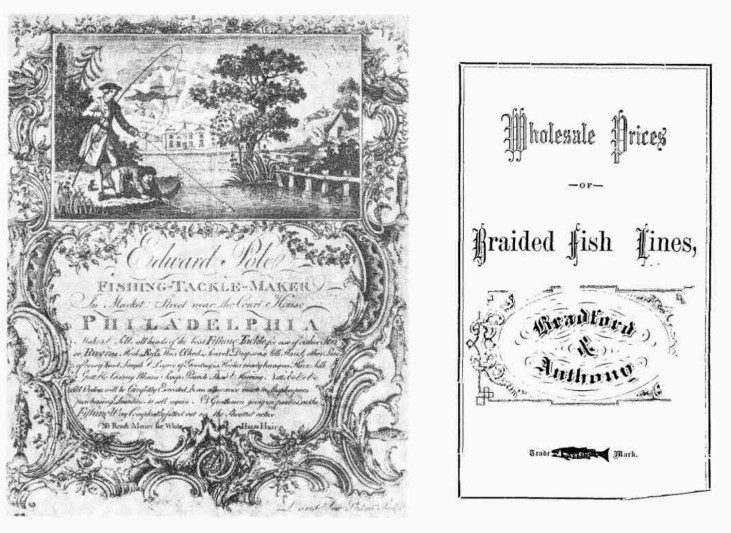
Catalog courtesy Leon Chandler.
Later in the book, Charles Cotton details the ideal specifications for a line.
“Now to have your line as it ought to be, two of the first lengths nearest to the hook should be of two hairs a-piece; the next three lengths above them of three; the next three above them of four; and so of five, and six and seven to the very top.“
This taper would develop by gradually increasing the number of hairs utilized as the line diameter progressed through a total of seventeen separate sections.
In dressing or “dyeing” the lines, Sir Izaak recommended a concise mixture of
…a pint of strong ale, half a pound of soot, and a little quantity of the juice of walnut-tree leaves, and an equal amount of alum.” After boiling and cooling this concoction, a line would be immersed in it until it would “turn [the] hair to be a kind of grass-color, or greenish.” The longer the line was soaked the darker it would become. We are advised that pale green is the most favorable shade, and that one should use a yellow line only “when the leaves rot.”
In early American periodicals of the 1700’s, advertisements by “Edward Pole – Fishing Tackle Maker” mentioned “ready money for white horse hair.”¹ This would indicate that raw materials were being acquired in the United States to manufacture lines and leader material. Another Pole advertisement hat appeared in 1777 mentioned that he marketed “the best green or white hair,silk, hardest, hempen, flaxen, and cotton lines”: he was simultaneously marketing horse hair, silk, and cotton lines. One can only speculate that Mr. Pole himself made these lines by hand with the use of the simple tools available at the time. During these early years of line making, each line was essentially a unique item which adhered to no established manufacturing standards.
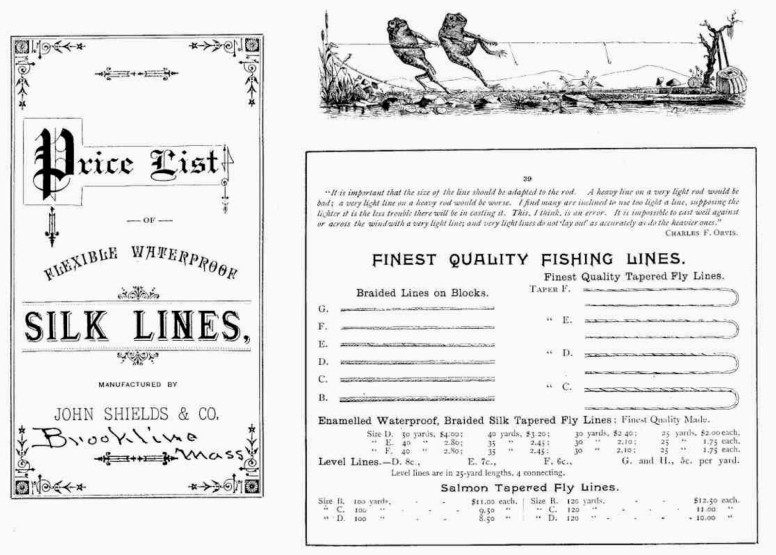
For the next seventy-five years the fly line continued to evolve until silk became the only material available in mid- to late nineteenth century catalogs. Charles Orvis’s personal scrapbook of 1870-1900 (in the Museum’s collections) includes two catalogs that offer silk lines. The first was published by Bradford & Anthony and reads “Wholesale Prices of raided
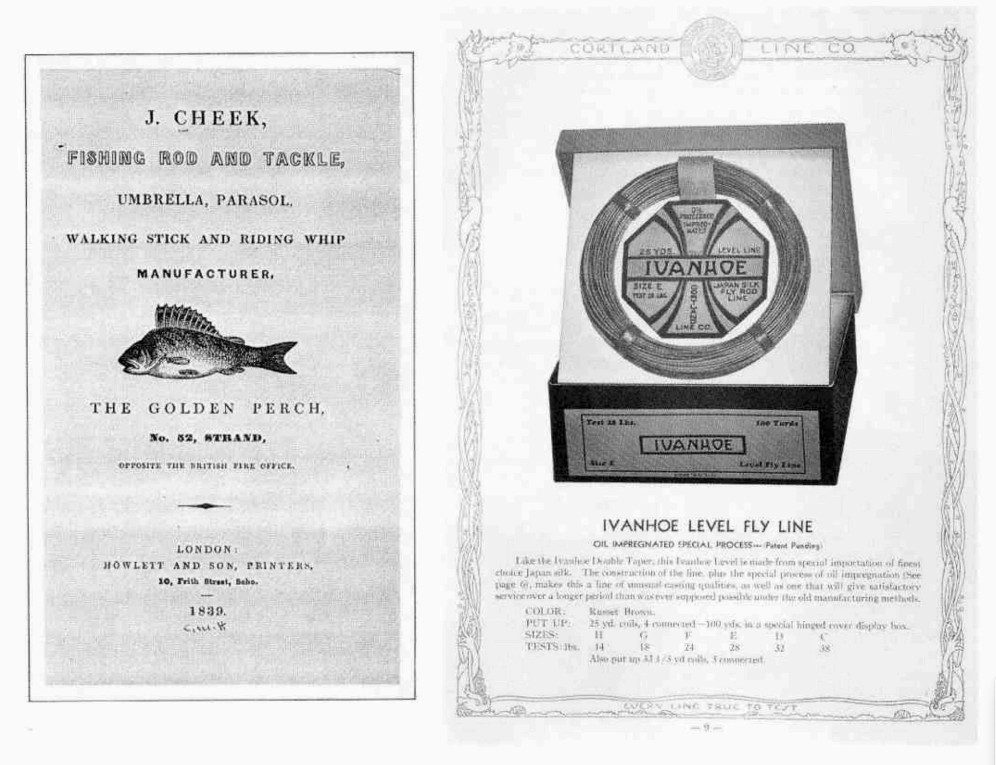
Fish Lines.” The second is more specific, offering “Flexible Waterproof Silk Lines” that were manufactured by John Shields & Company of Brookline, Massachusetts. An Orvis catalog shows that they marketed silk lines under their own label as early as 1889.4 And J. Cheek of London, “Manufacturer of Walking Sticks and Riding Whips,” made rod and silk lines for sale through his 1839 catalog.
The J. Cheek catalog reference is significant because it shows that Mr. Cheek was proficient in whip braiding, an early technique in the evolution of silk line manufacturing. More efficient textile manufacturing methods were implemented during the industrial revolution, and it is presumed that automated silk line production was derived from this
technology, affording it much greater availability. In hopes of learning more about the actual manufacture of silk lines, interviews were conducted with two gentlemen who have had firsthand experience with mechanized silk-line production.
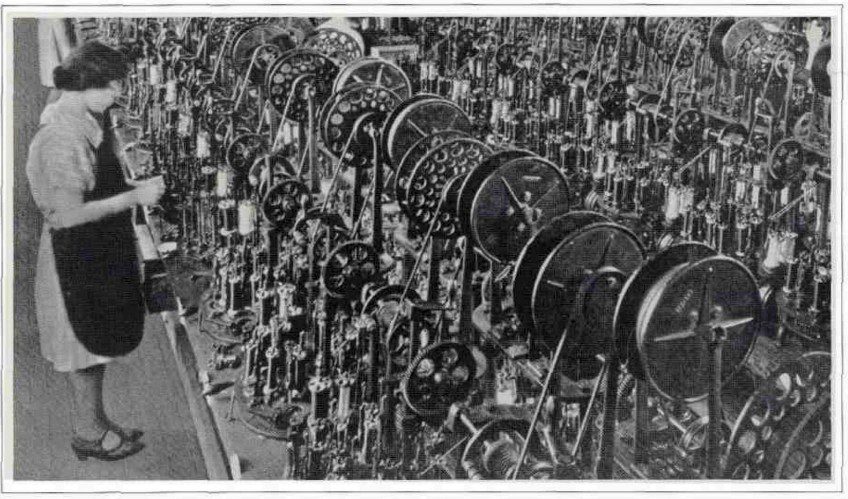
The Cortland Line Company was founded in 1915 under the leadership of Ray F. Smith, in Cortland, New York, and began mass producing silk fly lines in the early 1930s. Leon Chandler, president of the company, recalled in an interview how silk filaments were imported directly from Japan and were then built into threads by doubling and twisting at
Cortland’s mill. This thread was given to a Cortland operator who worked on a modified braiding machine. To produce a double taper line, the operator would begin with sixteen small threads at the line tip and develop the gradual taper by removing the smaller threads and replacing them by splicing in larger threads until the body of the line was formed. This process was then reversed to complete the tailing taper. Ninety-six total thread changes were required in order to complete a single line. The operator was responsible for eight machines, completing one 90-foot line per machine in an eight-hour shift. The production schedule called for two shifts: the first from 6:00 A.M. to 2:00 P.M., and the second from 2:00 to 10:00 P.M.
After the braiding was completed, the lines would undergo an oil impregnation process during which a continuous row of lines would be drawn through a blend of tongue and linseed oils and then fed into a two-story oven for drying. This impregnating process would be repeated a number of times. Once dry, a grinder was used to remove the excess oil buildup on the outside surface of the line. The entire manufacturing process would take several days to complete. Ivanhoe silk lines were one of Cortland’s earliest introductions.
Chet Cook of the U.S. Line Company of Westfield, Massachusetts, was involved with silk line production from the mid 1940’s through the early 1960’s. U. S. Line was originally known as the U. S. Whip Company (another example of how silk line production evolved from whip
making). They were once the largest manufacturer of whips in the world and helped Westfield earn its reputation as the Whip City. But when the automobile came into widespread use, they had to adapt their product line in order to survive. Company management assumed that they could readily convert their braiding equipment from whip-making to fishing line production. Unfortunately, this was not the case, so they purchased the necessary equipment and began operation as the U. S. Line Company.
Chet recalls in an interview that U. S. Line purchased its silk directlyfrom Japan and had it refined and spun into thread by the now defunct Mason Silk Company of Winsted, Connecticut. Each thread was built by twisting three filaments into a strand and then twisting the three strands together to form a working thread. Sixteen threads were needed to braid a line.
The factory assigned 100 out of 600 braiding machines to tapered fly line production; the remainder were used for bait casting and trolling lines. Each operator working on fly lines was responsible for five machines. On these machines, mechanized counters would feed specified amounts of thread into production and then shut off, enabling the operator to splice in the various sized threads required for developing the taper.
As each line was completed, a colored marker was tied in and the operator would begin the next line; up to thirty lines were braided in one continuous length. This parade of lines was wound onto a skein that was then dipped into boiling linseed oil for impregnating. They were drip dried by rotating the skein every half hour for several hours, and were dried further by being placed in a 200- degree oven for four hours.
After sitting for a day, they were honed by being fed over a curved metal disk that would rotate in place. The lines went through this entire process six or seven times until a smooth surface was achieved. When hand and visual inspections of the final finish were complete, the lines would be coiled as they were unwound from the skeins. Workers would then remove the thread marker that was tied in during braiding and cut the individual lines off.
Although Cortland and U. S. Line began mass producing silk lines during the early 1930’s, lines made by similar processes were being marketed by Abercrombie & Fitch as early as 1911. These lines were produced according to the British “Halford Process,” in which a braided silk line was immersed in a container of boiling linseed oil and kauri gum varnish.6 The container was sealed and had the air pressure within it reduced with a pump. By reducing the pressure, air SILK was able to escape from the line so that when the pressure was brought back to normal, oil would penetrate the line. A smooth surface was achieved by repeated coating and drying. The excess coating was removed by hand with a pumice stone and the line was polished with talcum powder. These and many other lines made of silk were marketed during the late nineteenth and early twentieth centuries.
Silk line specifications were based on an alphabetical system, believed to be British in origin, each letter designating the diameter of the line tapers.7 For example, an HDH line had a front taper of 25/1,000 of an inch, 15/1,000 inch body, and an end taper of 25/1,000 of an inch. A CВС was 50/1,000 inch, 55/1,000 inch, and 30/1,000 inch. Thus B signifies 5/1,000 of an inch; C is 30/1,000; D is 45/1,000; and H is 25/1,000. This gauging system was widely accepted by line manufacturers of the day.
The demise of the silk line began during World War II when nylon was introduced. The product of chemical and scientific breakthroughs, introduced by the E. I. DuPont De Nemours & Company, Inc., nylon was less expensive and easier to produce. Nylon’s major shortcoming was that it did not hold the impregnating oils as well as silk. This problem was solved by coating a level line with synthetic repellent materials that were then moulded to the desired tapers. The SILK technology behind the development of nylon lines was the direct result of ideas that grew out of the manufacture and use of horsehair and silk lines- lines which play a proud and innovative role in angling history.

