
Unlocking the Secrets of the Marvin Hedge 7 Taper: How the First Weight-Forward Fly Line Was Born
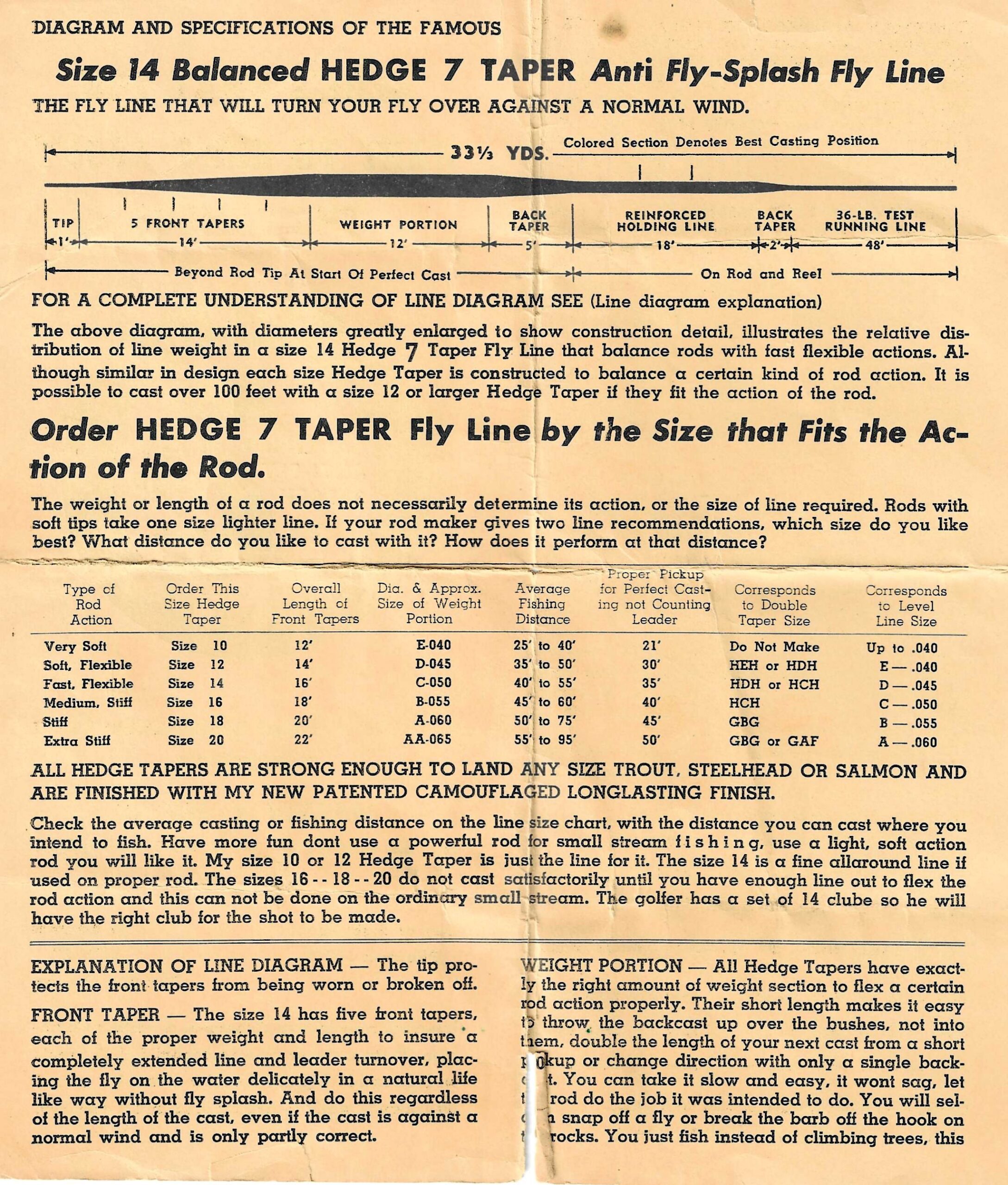
Some time ago a friend from the United States wrote to me asking if it would be possible to reproduce the legendary HEDGE 7 TAPER, the first known weight-forward fly line. My friend sent me a document, an advertising publication from the 1940s which reports the measurements and diameters of the famous fly line.
For classic tackle enthusiasts and bamboo rod builders, few artifacts hold the mythical status of the Marvin Hedge 7 Taper. By examining archival documents, vintage catalogs, and original patent blueprints, fly-fishing historians have uncovered the blueprint needed to bring the “Lost Silk Line” back to life.
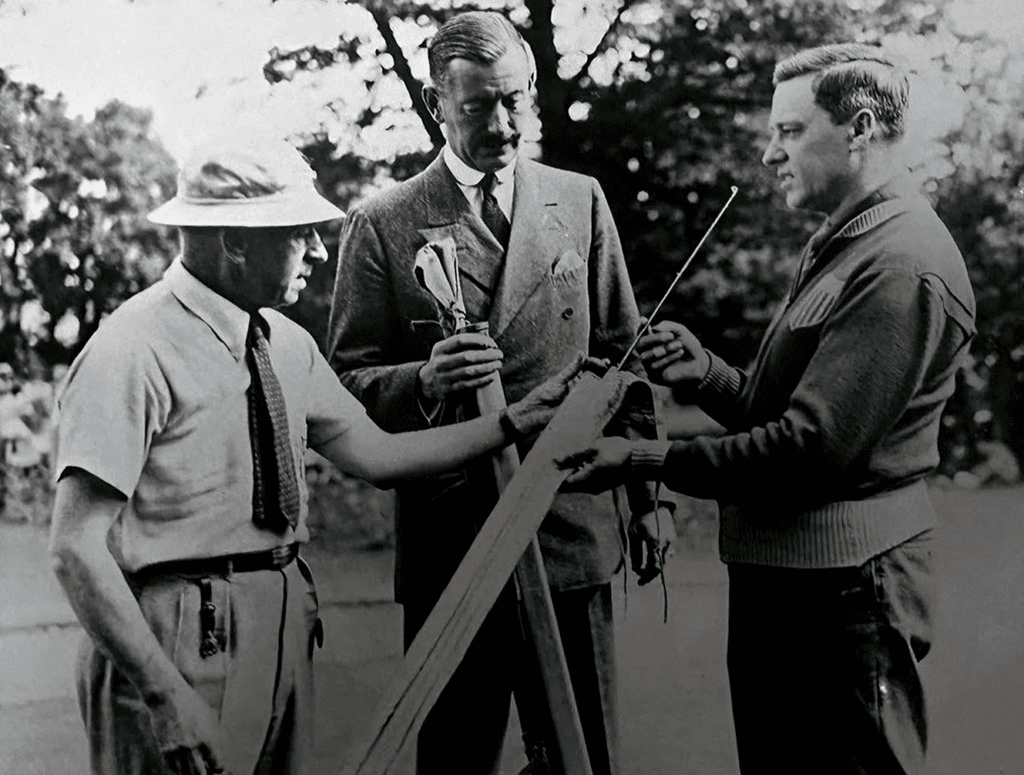
Marvin Hedge (1893–1962) was a legendary tournament fly caster from Portland, Oregon, best known as the pioneer of modern fly casting. Widely recognized as the pioneer of modern fly casting, Marvin Hedge forever changed the sport in 1934 by introducing the “double haul” technique and inventing the world’s first weight-forward (WF) shooting taper fly line.
The Genesis of Modern Distance Casting In 1934, at the National Casting Tournament, Marvin Hedge stunned the angling world by demolishing Walter Mansfield’s distance record with a staggering 147-foot cast. Media outlets swarmed the event, filming his revolutionary casting mechanics. Two years later, the record was pushed to an incredible 179 feet.
While the newly minted double-haul technique provided the kinetic energy, the physical weapon behind the feat was a custom, never-before-seen fly line. Until Hedge, anglers used level lines or traditional double-taper (DT) lines that distributed weight evenly, making extreme distance casting inefficient due to air resistance and friction. Hedge’s solution concentrated the mass forward in a heavy shooting head, backed by a ultra-thin, low-friction running line.
Commercial Production and the Hardy Bros. Collaboration By 1938, Hedge partnered with the legendary British tackle house Hardy Bros. to introduce commercial versions of his design. Cataloged as the “Marvin K. Hedge 7 Taper,” these lines were manufactured by the SA Jones Line Company of Norwich, New York.
The line was Available in tournament lengths of 43 and 53 yards, stocked in 11 distinct sizes—numbers 10, 12, 14, 16, 18, 20, 22, 26, 70, 75, and 80—ranging from “Fly Weight” to “Heavyweight Distance Tournament.” These lines appeared in catalogs for only a single year. The onset of World War II abruptly halted trans-Atlantic trade and commercial importation from the United States, though some historians suggest distribution later shifted domestically through the Heddon Rod Co.
Decoding the Blueprint: U.S. Patent 2,250,832 Finding the missing physical dimensions required tracing Hedge’s official intellectual property. On April 18, 1939, Hedge filed an application with the U.S. Patent Office, which was officially registered on July 29, 1941, under Patent No. 2,250,832.
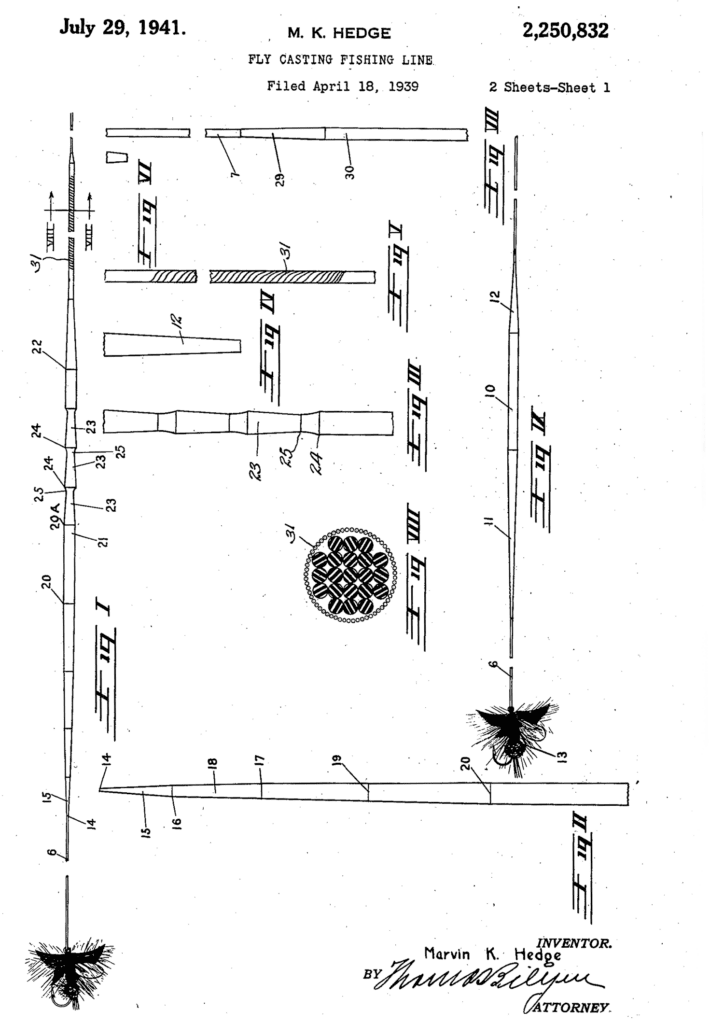
This document serves as the absolute Rosetta Stone for modern replicators. It outlines the exact geometric transitions required to bridge the heavy forward belly with the elusive, lightweight running line (the “lost line”). Unlike modern synthetic PVC or polyurethane lines, historical reproduction requires braiding silk, applying precise oil-based dressings, and hand-rubbing multiple coats to achieve the historical suppleness, floating capability, and grain-weight distribution specified in Hedge’s original text.
Recreating the Legend Today Reverse engineering a vintage silk weight-forward line bridges the gap between historical preservation and modern craftsmanship. For traditional anglers looking to pair a historic bamboo fly rod with its period-correct counterpart, understanding Hedge’s original tapers offers a window into the golden age of tournament casting. Rebuilding the Hedge 7 Taper proves that the innovations shaping modern fly fishing were perfected nearly a century ago.
Bibliografy
Primary Documentation & Patents
- Hedge, M. K. (1941). Fishing Line. U.S. Patent No. 2,250,832. U.S. Patent and Trademark Office. (Filed April 18, 1939; Issued July 29, 1941). This is the foundational primary source document detailing the explicit geometric measurements, construction ratios, and tapers designed for the breakthrough weight-forward design.
Historical Trade Catalogs & Periodicals
- Hardy Bros. Ltd. (1938). Anglers’ Guide and Catalogue. Hardy Bros., Alnwick, England. (Featuring the introductory listing of the “Marvin K. Hedge Taper” tournament lines manufactured by the SA Jones Line Company).
- Popular Science (1939–1941 archival editions covering tournament casting milestones and contemporary inventions by Marvin Hedge and contemporaries like Peter Ross).
Angling History and Secondary Literature
- Borger, G. Origins of Fly Casting. Published via Fly Fishers International historical essays and documentation series, outlining the mechanics of the 1934 distance records and the evolution of shooting heads.
- California Fly Fisher Archives (2021). Floating Lines and Sink-Tips for Steelhead. Comprehensive historical overview tracking the transition from horsehair and woven silk fiber lines to tournament shooting heads established by Marvin Hedge in Portland, Oregon during the 1930s.
- The PowerFibers Journal / Eclectic Angler Archives. Dedicated historical monographs tracking pre-synthetic line construction, silk braiding techniques, and oil-dressing applications used by vintage American line manufacturers such as the SA Jones Line Company of Norwich, NY.
